In a groundbreaking development for women’s healthcare in Nigeria and West Africa, the
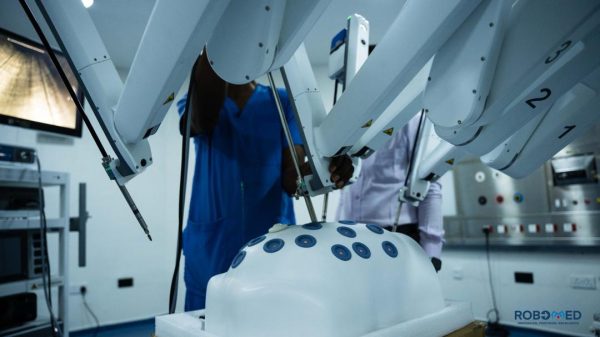
first-ever robotic-assisted laparoscopic myomectomy surgery using the Microport Toumai MT-1000 surgical robot was successfully performed at Nisa Premier Hospital in Abuja.
The procedure, which was a collaboration with Robomed Global marks a significant step forward in the adoption of advanced robotic surgery for women in the region.
The patient, a young woman who had been suffering from symptomatic uterine fibroids, underwent the surgery following ultrasound confirmation of the diagnosis.
The procedure
was completed with remarkable precision, minimal blood loss, and small surgical scars.
The patient was discharged from the hospital within 48 hours of surgery and required no blood transfusion. She reported minimal pain and expressed immense gratitude for her
care.
The Surgeons
The operation was led by Dr. Ahmed Abdullahi, a UK Cambridge fellowship trained gynecologist with advanced training in minimally invasive gynecologic surgery and a faculty member of the Robomed Academy. He was assisted by Dr. David Ejenobo, consultant gynecologist at Nisa Premier Hospital and a Robomed Academy trainee, who served as bedside assistant and provided intraoperative support. “I am thrilled to be part of this historic moment,” Dr. Abdullahi said after the procedure. “The Toumai robot offers
unparalleled precision and control, which makes a huge difference in the outcome for the patient. The ability to remove fibroids with minimal trauma, smaller incisions, and reduced recovery time will change the way we treat gynaecological conditions in Nigeria and across
West Africa.”
“This surgery is a testament to the future of healthcare in West Africa,” said Dr. Ejenobo.
“With advanced technologies like robotic surgery, we are moving closer to providing our
patients with the highest standards of care right here at home. It’s a new era for women’s health, and I am proud to be a part of it.”
The Role of Robotic Surgery in GynaecologyRobotic-assisted laparoscopic surgery is used for the treatment of a wide range of gynaecological conditions, including fibroids, endometriosis, benign and cancerous gynaecological tumours.
One of the main benefits of robotic surgery is the reduction in blood loss, which is crucial in procedures like myomectomy where fibroids are often large and vascular. Additionally, the use of smaller incisions results in reduced postoperative pain, less days in the hospital, quicker return to usual activities and less scaring for the patient.
All these offer significant advantages over traditional surgical methods.
For Dr. Abdullahi, who is also deeply committed to training the next generation of robotic surgeons through the Robomed Academy, the successful surgery is not just a personal achievement, but a victory for the broader medical community in Nigeria and West Africa.
“By making this technology available to our region, we are creating opportunities for better patient outcomes and better training for local surgeons. Robotic surgery is a gamechanger, and I am proud to be part of this movement,” he added.
A New Era for Women’s Health in West Africa
The success of this procedure represents a monumental step toward making robotic
surgery more accessible to women in Nigeria and West Africa. For years, patients seeking advanced treatments for gynaecological conditions often had to travel abroad for procedures that are now available locally.
Robomed is leading efforts to bring this cutting-edge technology to Nigeria and train local surgeons thereby contributing to Nigeria’s brain gain. The company is dedicated to improving access to high-quality healthcare by introducing robotic surgery into hospitals
across the region, training local surgeons,and supporting the development of world-class medical infrastructure.
“This milestone shows what is now possible for women seeking high-quality surgical care locally,” said Dr. Obi Ekwenna, CEO of Robomed Global. “By pairing advanced technology with structured training, we are strengthening local capacity and improving access to care that previously required travel abroad.”
A Bright Future for Gynaecological Treatment in West Africa
As the healthcare landscape in Nigeria and West Africa evolves, the integration of robotic surgery into everyday medical practice promises to bring about lasting change. By providing a faster, less invasive, and more precise alternative to traditional surgeries, robotic technology has the potential to improve patient outcomes and reduce the strain on healthcare systems.
The successful myomectomy at Nisa Premier Hospital is just the beginning, and it is
expected to inspire further adoption of robotic surgery in treating gynaecological issues across the region.
With the successful completion of this surgery, the Robomed team and Nisa Premier
hospital have set a new standard for the delivery of high-quality, minimally invasive care in Nigeria and beyond. The future of robotic surgery in the region looks brighter than ever.
About Robomed Global:
Robomed Global is a leading medical technology company dedicated to advancing
healthcare in Nigeria and West Africa through the introduction of robotic surgical systems and mobilizing highly experienced personnel from the USA and Europe to provide training for local surgeons, perioperative nurses and biomedical engineers. The company works closely with healthcare systems to improve patient safety through integration of cuttingedge technologies.