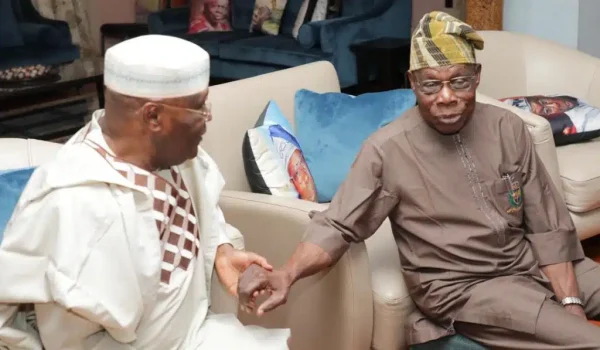
Paul Ibe, media adviser to former Vice President and African Democratic Congress (ADC) presidential candidate Atiku Abubakar, has accused former President Olusegun Obasanjo of maintaining a persistent campaign of falsehoods and political character assassination against his principal.
In an official statement released on Sunday, Ibe argued that Obasanjo has routinely resurrected allegations of corruption, betrayal, and political misconduct during election cycles for political convenience.
Ibe’s response follows recent comments by former President Obasanjo alleging that Atiku mobilized the late former Speaker of the House of Representatives, Ghali Umar Na’Abba, to initiate impeachment proceedings against him while both men were in office between 1999 and 2007.
Refuting the claim, Ibe described the allegation as baseless and noted that Na’Abba, who passed away in December 2023, is no longer alive to address the accusation directly.
“Former President Olusegun Obasanjo’s campaign of lies, political manipulation, and orchestrated deceit stacked against Atiku Abubakar for over 20 years, for political expediency, is falling apart like a pack of cards,” Ibe said. “On July 23, Chief Obasanjo alleged that his deputy and presidential candidate of the African Democratic Congress, Atiku Abubakar, mobilised the late former Speaker of the House of Representatives, Rt. Hon. Ghali Umar Na’Abba, to impeach him.”
Ibe highlighted counter-accounts from former Chief Whip of the House of Representatives, Abubakar Bawa Bwari, who was active during the period. According to Bwari’s account, Na’Abba never sought Obasanjo’s removal, and Atiku acted as an envoy on behalf of the presidency to mediate with lawmakers.
The statement also disputed long-standing reports that Obasanjo was forced to kneel before Atiku to secure his backing for a second presidential term in 2003.
Ibe cited video evidence featuring former Abia State Governor Orji Kalu, who stated that it was Atiku who pleaded with PDP governors to remain loyal to Obasanjo.
“Atiku knelt down; we were like 17 governors,” Kalu said in the cited video. “He knelt down for us and said that he does not want to be disloyal to Obasanjo—that four years is like four days.”
According to Kalu’s recollection, several PDP governors had been preparing to back Atiku to replace Obasanjo ahead of the 2003 convention due to concerns over the former president’s governance style. However, Atiku refused to challenge his principal, stating he could not betray the trust Obasanjo had placed in him.
Revisiting the controversial probe into the Petroleum Technology Development Fund (PTDF) prior to the 2007 general election, Ibe recalled that Obasanjo had written to the Senate requesting an investigation into Atiku over alleged diversion of funds.
Ibe noted that Atiku voluntarily waived his immunity to appear before the investigative panel, maintaining that the funds were safely placed in fixed deposit accounts. Atiku maintained that the investigation was politically motivated to stifle his presidential ambitions after he opposed Obasanjo’s third-term bid.
The media adviser also referenced the autobiography of the late Awujale of Ijebuland, Oba Sikiru Kayode Adetona, titled Awujale, alleging that the monarch documented how the Economic and Financial Crimes Commission (EFCC), under Nuhu Ribadu, was deployed against businessman Mike Adenuga as part of the broader PTDF dispute.